Crude Oil Price Projections for 2026 And 2027
In today’s world, crude oil is a key foundation of many countries’ economies. It is an important commodity, and any change in its price can have ripple effects through the broader economy. When oil prices rise, other commodities that depend on it also rise.
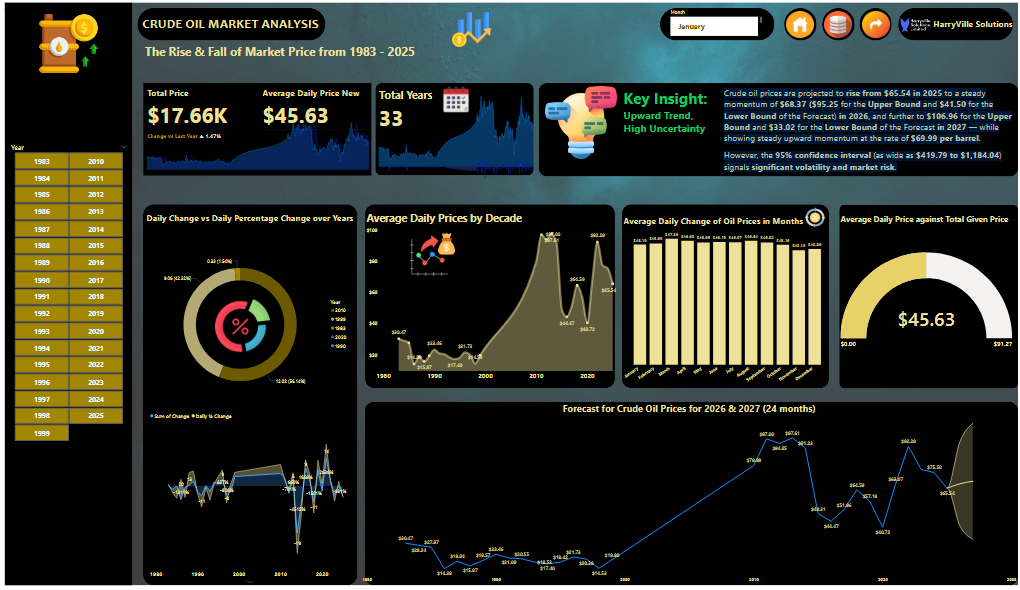
Because of the importance of oil prices to the global economy, HarryVille solutions conducted an analysis of crude oil prices from 1983 to 2025 to observe the trend and make 2-year predictions. Projecting oil prices is important because it gives a clue on how the economy will behave in the future. It has been noted that an increase in oil prices can cause inflation as it is a key input for production and transportation. So, any change in the prices is an indication of the health situation of the global economy.
According to the theglobaleconomy, oil accounts for 2.69% of the GDP in the world, and Libya has the highest value, 56.38%, from 1970 to 2021. This shows the importance of crude oil in the global market.
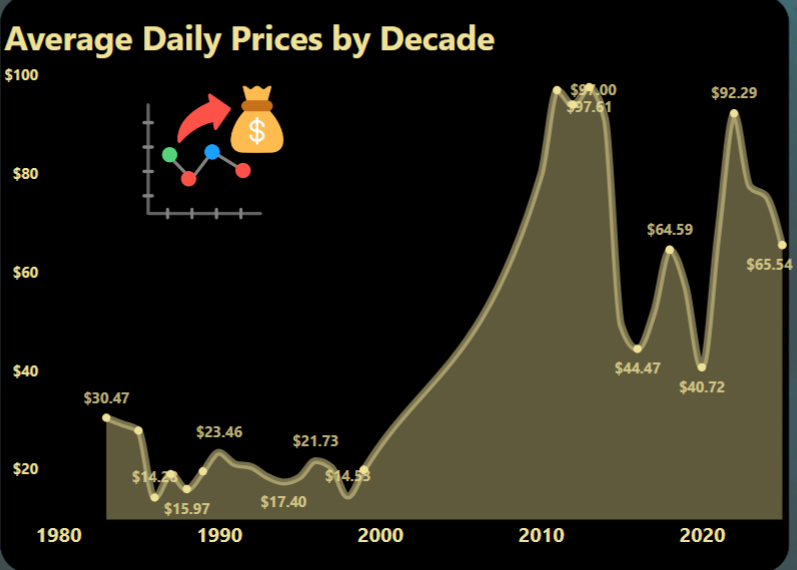
Our analysis shows that the average daily price of crude oil is $46.63 from 1983 to 2025. In March and April 2011, the oil price per barrel reached an all-time high, $106.72 and $113.93, respectively. This is the first time since 1983 that the oil price will cross $100. The civil war in Libya, violence in Nigeria, and instability in the Middle East were the major drivers. Since then, oil prices haven’t fallen below $40.
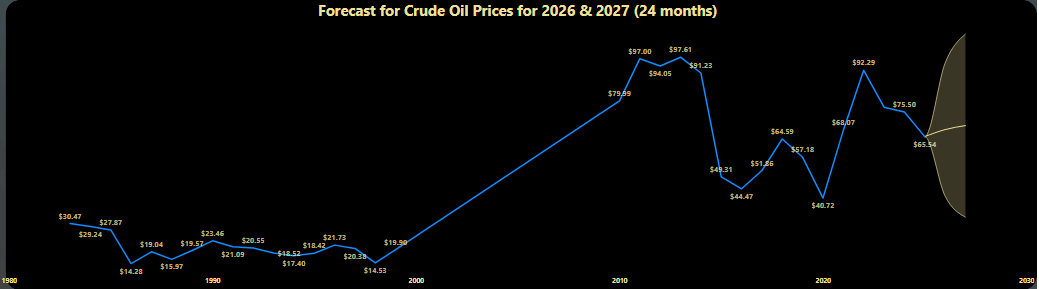
We took a step further and projected crude oil prices for 2026 and 2027 after building our model to learn from the previous dataset. We projected crude oil prices to rise from $65.54 in 2025 to a steady momentum of $68.37 ($95.25 for the Upper Bound and $41.50 for the Lower Bound of the Forecast) in 2026, and further to $106.96 for the Upper Bound and $33.02 for the Lower Bound of the Forecast in 2027 — while showing steady upward momentum at the rate of $69.99 per barrel. However, the 95% confidence interval (as wide as $419.79 to $1,184.04) signals significant volatility and market risk.