Analysis on UK Housing Rental Prices

Rental prices in the UK have exceeded incomes for a decade, straining affordability—especially for younger people, low-income earners, students, and recent migrants. Despite some slowdown since the post-pandemic surge, rents remain high nationwide.
Average private rents in the UK have steadily risen, mainly due to a mismatch between supply and demand. London faces particularly high rents due to job growth, population growth, and limited supply. Other regions, though cheaper, have seen faster percentage increases as demand spreads from expensive cities.
At Harryville Solution Ltd, we conducted an analysis of the UK housing rental prices. The aim is to understand the trend in prices over the years we considered.
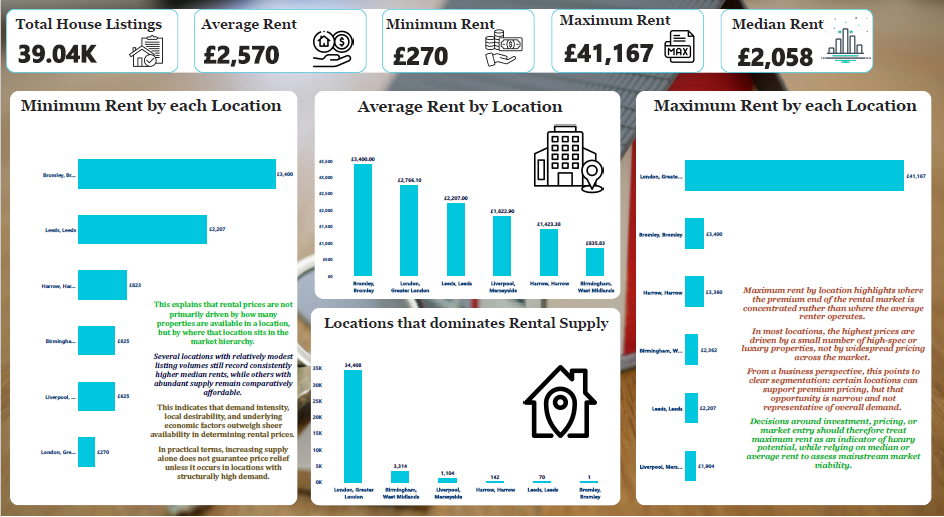
Minimum Rent by Each Location
This explains that rental prices are not primarily driven by the number of properties available in a location, but by where that location sits in the market hierarchy. Several locations with relatively modest listing volumes still record consistently higher median rents, while others with abundant supply remain comparatively affordable.
This indicates that demand intensity, local desirability, and underlying economic factors outweigh sheer availability in determining rental prices. In practice, increasing supply alone does not guarantee price relief unless it occurs in areas with structurally high demand.
Maximum Rent by Each Location
Maximum rent shows where luxury rentals cluster, not where most renters pay. Usually, a few luxury properties drive these prices, not the average rental market.
From a business perspective, only some areas support luxury pricing, and those areas are limited. Use maximum rent to gauge luxury potential. Rely on median or average rents to judge broader market opportunities.
Property size and Price Structure
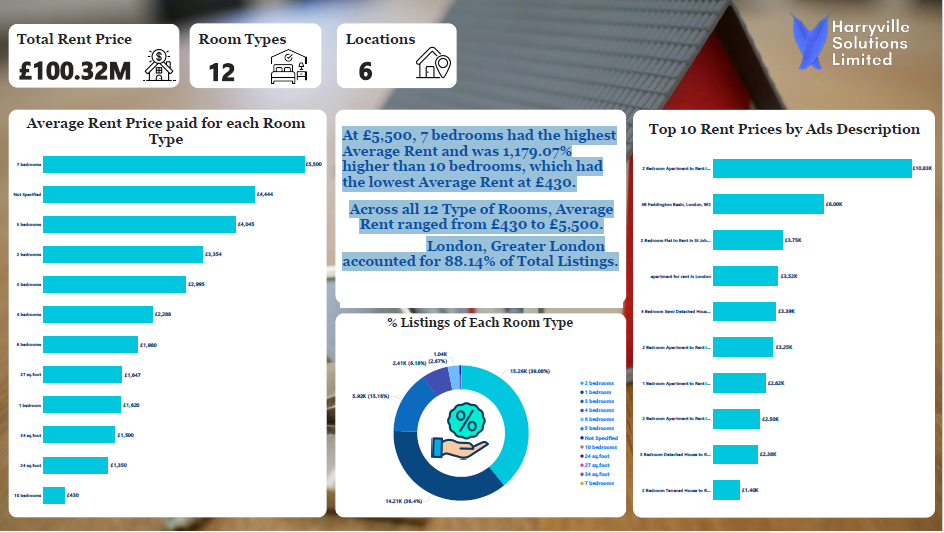
At £5,500, 7 bedrooms had the highest average rent and was 1,179.07% higher than 10 bedrooms, which had the lowest Average Rent at £430.
Across all 12 type of Rooms, average Rent ranged from £430 to £5,500. London, Greater London accounted for 88.14% of Total Listings.
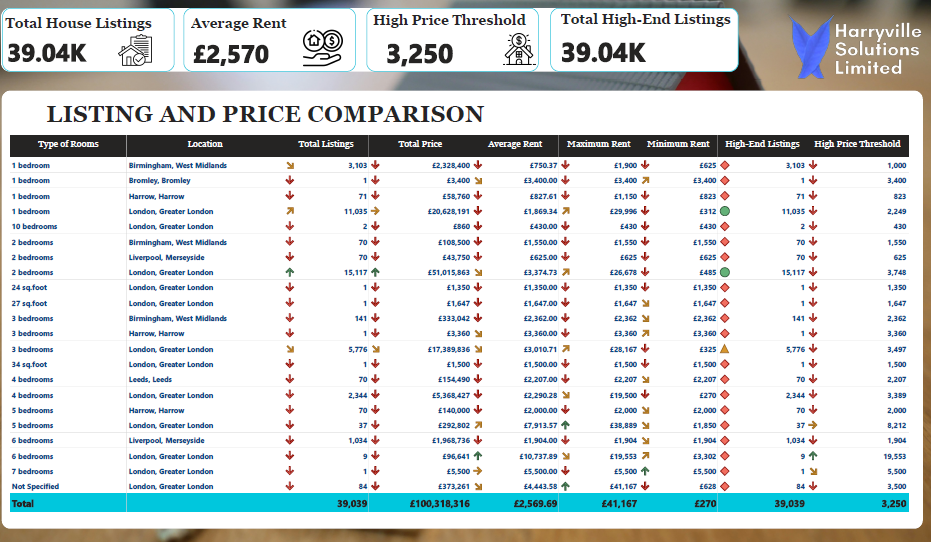
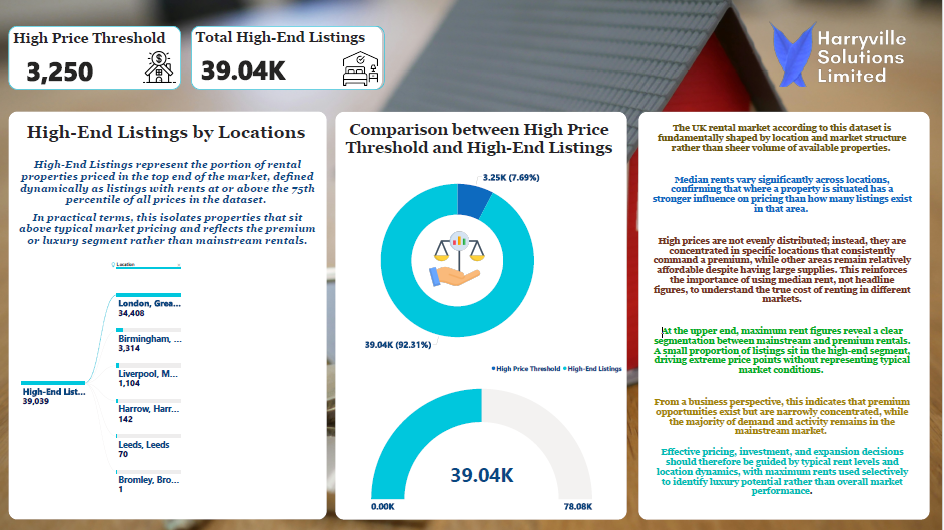
The UK rental market, according to this dataset, is fundamentally shaped by location and market structure rather than sheer volume of available properties. Median rents vary significantly across locations, confirming that where a property is situated has a stronger influence on pricing than the number of listings in that area.
High prices are concentrated in specific locations that consistently command a premium, while other areas with large supplies remain relatively affordable. This contrast underscores why median rent, rather than overall price figures, provides a clearer basis for comparing the true cost of renting across markets.
At the upper end, maximum rent figures reveal a clear segmentation between mainstream and premium rentals. A small proportion of listings sit in the high-end segment, driving extreme price points that do not reflect typical market conditions.
For business, this shows premium opportunities are tight, while most demand is in the mainstream market.
Base pricing, investment, and expansion on typical rents and location dynamics, using maximum rents only to spot luxury potential, not to represent the full market.